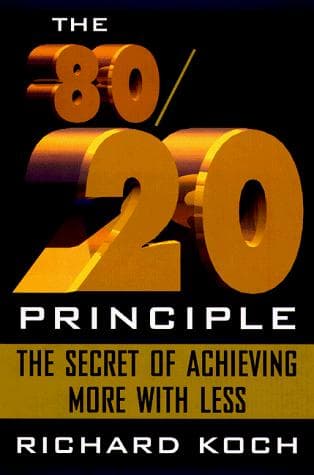
The 80/20 Principle
Richard Koch
What this book is about
The 80/20 Principle by Richard Koch is a productivity title with reader perspectives, questions, and applications gathered around it.
Best formakersstudentsknowledge workers
1997
Effort and results are not proportionate, and almost nobody checks which of theirs is which.
Who it helps: People working hard across everything and getting results in only a few places.
What it argues
A small part of what you do produces most of what you get.
Koch's case is that the imbalance between input and output recurs across sales, customers, faults and time, and that most planning assumes a proportionality that does not hold. The ratio is not the point; the asymmetry is.
You cannot guess which fifth it is.
People reliably nominate the work that felt hardest or took longest rather than the work that produced the result. The principle only pays once the split is measured, which is why so few people who quote it have actually applied it.
What you can do
Measure one month before you cut anything.
Identifying the productive fifth requires data on where results actually came from, kept over long enough to be more than a story. A month of rough records beats any amount of reasoning about it.
Try this
For four weeks, log where results came from - clients, channels, tasks. Then look at the distribution.
I tried this
Reader perspectives
See where the ideas worked, failed, or changed
Only perspectives readers have actually contributed appear here.
No reader perspective has been added yet. Share what you applied, questioned, or disagreed with.
Add a perspectivePerspectives
What readers learned, applied, or challenged
Open a perspective to see what a reader applied, questioned, challenged, or learned.
Often read next
Related books to continue with after you have seen the conversation around this one.
Read Next
Atomic Habits
James Clear
Its value is the concrete system it gives readers for examining cues, environments, repetition, and identity instead of relying on motivation alone.
Best for habit builders
Read Next
The Psychology of Money
Morgan Housel
It gives readers a useful starting language for discussing why reasonable people can make very different choices with money.
Best for new investors
Read Next