Book
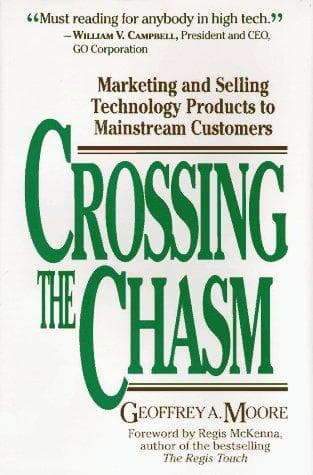
Crossing the Chasm
The idea from Crossing the Chasm that deserves a second reading
Written by the BookSphere team to start this shelf off. What would change this week if you treated this book as a practice instead of a take-away?
Genre
Founder, product, growth, and early-company books with practical reader perspectives.


Find in Startups
Search within Startups. If the book lives elsewhere in BookSphere, we will show that too.

Startups
Peter Thiel and Blake Masters
It gives founders and product builders a sharp framework for discussing innovation, independent thinking, durable advantage, and how new ideas reach a market.

Business
Clayton M. Christensen
Use the reader perspectives to understand what people took from this book and decide whether it deserves your full attention.

Business
Geoffrey A. Moore
Use the reader perspectives to understand what people took from this book and decide whether it deserves your full attention.

Business
Eric Ries
It remains a useful common language for testing uncertainty, especially when readers also discuss where experimentation can become shallow or misleading.
Start here
Curated sequences that help readers know what to read next.
Curated books that make the best first impression.

Editor’s Pick
Peter Thiel and Blake Masters
It gives founders and product builders a sharp framework for discussing innovation, independent thinking, durable advantage, and how new ideas reach a market.
Best for founders

Editor’s Pick
Clayton M. Christensen
Use the reader perspectives to understand what people took from this book and decide whether it deserves your full attention.
Best for operators

Editor’s Pick
High-value starting points selected for this reading room.

Core Book
Peter Thiel and Blake Masters
It gives founders and product builders a sharp framework for discussing innovation, independent thinking, durable advantage, and how new ideas reach a market.
Knowledge guide

Core Book
Clayton M. Christensen
Use the reader perspectives to understand what people took from this book and decide whether it deserves your full attention.
Best for operators

Core Book
Accessible entry points with practical takeaways.

Beginner Essential
Eric Ries
It remains a useful common language for testing uncertainty, especially when readers also discuss where experimentation can become shallow or misleading.
Knowledge guide

Beginner Essential
Peter Thiel and Blake Masters
It gives founders and product builders a sharp framework for discussing innovation, independent thinking, durable advantage, and how new ideas reach a market.
Knowledge guide

Beginner Essential
Less obvious books worth discovering.

Hidden Gem
Rob Fitzpatrick
Use the reader perspectives to understand what people took from this book and decide whether it deserves your full attention.
Best for founders

Hidden Gem
April Dunford
Use the reader perspectives to understand what people took from this book and decide whether it deserves your full attention.
Best for founders

Hidden Gem
New additions to this reading room.
Recently Added
Alistair Croll
Use the reader perspectives to understand what people took from this book and decide whether it deserves your full attention.
Added Jun 28
Recently Added
Colin Bryar
Use the reader perspectives to understand what people took from this book and decide whether it deserves your full attention.
Added Jun 27
Recently Added
Clayton M. Christensen
Reader notes
Where readers apply, challenge, and explain the ideas behind these books.

Book
Crossing the Chasm
Written by the BookSphere team to start this shelf off. What would change this week if you treated this book as a practice instead of a take-away?
Geoffrey A. Moore
Use the reader perspectives to understand what people took from this book and decide whether it deserves your full attention.
Best for operators
Geoffrey A. Moore
Use the reader perspectives to understand what people took from this book and decide whether it deserves your full attention.
Best for operators
Clayton M. Christensen
Use the reader perspectives to understand what people took from this book and decide whether it deserves your full attention.
Best for operators
Peter Thiel and Blake Masters
It gives founders and product builders a sharp framework for discussing innovation, independent thinking, durable advantage, and how new ideas reach a market.
Knowledge guide
Use the reader perspectives to understand what people took from this book and decide whether it deserves your full attention.
Added Jun 27

Book
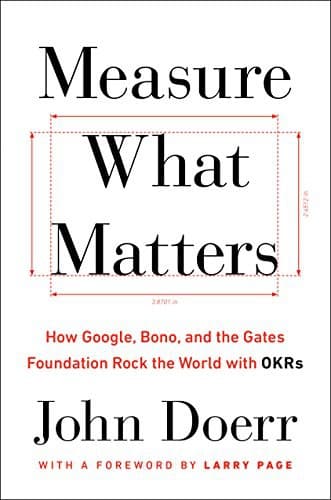
Measure What Matters
Written by the BookSphere team to start this shelf off. What would change this week if you treated this book as a practice instead of a take-away?

Book
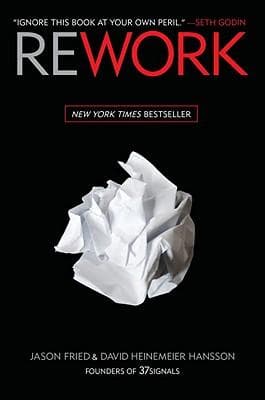
Rework
Written by the BookSphere team to start this shelf off. What would change this week if you treated this book as a practice instead of a take-away?

Book
The Hard Thing About Hard Things
Horowitz says directly that there is no recipe for the hard things, and then spends the book on situations where every option is bad. Layoffs, demoting a loyal friend, telling the truth to people who will leave because of it. That structure is the argument. Most business books present decisions with a right answer that was obvious in retrospect. This one presents decisions where the person deciding did not know, and where the outcome does not settle whether the call was correct. The weakness is the same as the strength. Advice drawn from one operator's crises does not obviously generalise, and the book does not claim it does. What decision are you carrying where you still cannot tell whether you got it right?

Book
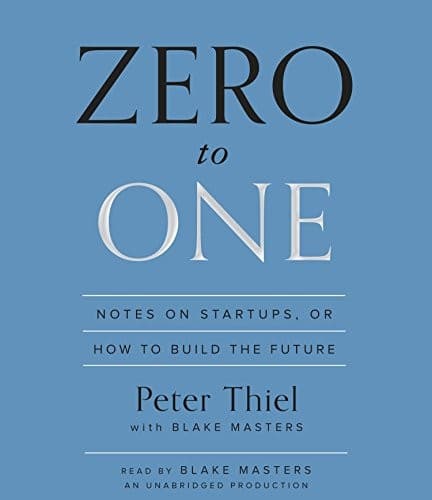
Zero to One
The famous interview question is what important truth do very few people agree with you on. It sounds like an invitation to be provocative. It is closer to a test of whether you have any first-hand knowledge at all. Most answers fail in one of two directions: they are merely unpopular opinions with no evidence, or they are consensus views stated aggressively. A real answer requires you to have seen something others have not had access to. The deeper argument in the book is that competition destroys profit, and that most people compete because it is legible rather than because it is wise. That claim is much more contestable than the monopoly framing suggests, and the book is thin on cases where monopoly harmed the customer. What would you actually answer? And how would you know it was knowledge rather than taste?

Book
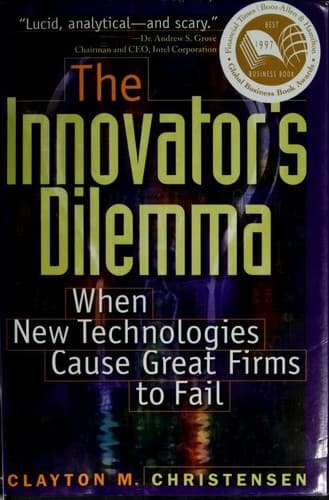
The Innovator's Dilemma
Christensen's argument was narrow and testable: incumbents lose because they rationally serve their best customers, while a cheaper, worse product improves from below until it is good enough. The word has since been stretched to cover any successful new entrant. Uber is the standard counterexample; by the original definition it was not disruptive, it was a better product entering at the top. Christensen said so himself. The theory has also faced empirical challenge, notably Jill Lepore's argument that the case selection favoured the conclusion and that several disrupted incumbents did fine. Does the narrow version still predict anything? Where have you seen a genuine low-end entry that incumbents rationally ignored?
Book
Good Strategy Bad Strategy
Rumelt's kernel is diagnosis, guiding policy, coherent action. The test he offers is simple and brutal: if your strategy does not identify a specific obstacle, it is not a strategy. By that standard most corporate strategy is bad strategy in his precise sense. Ambitious targets, values statements and a list of initiatives that do not reinforce each other. The tell is that you could swap the company name and the document would still read fine. The uncomfortable implication is that real strategy requires saying what you will not do, which is politically expensive in a way that goal-setting is not. What is the best diagnosis you have seen written down? Not the plan, the diagnosis.

Book
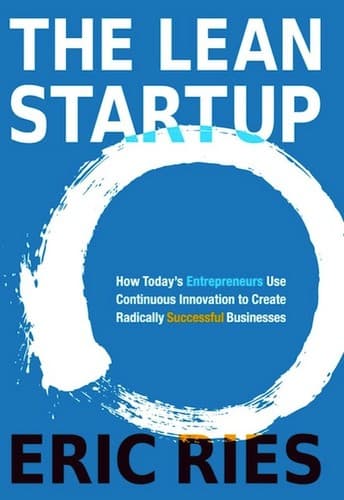
The Lean Startup
Ries defined the minimum viable product as the smallest experiment that produces validated learning. In practice the term got used to justify shipping a thin product and calling the resulting silence data. The distinction the book makes and most teams drop is that an MVP is an experiment with a hypothesis attached. Without a stated hypothesis and a threshold that would falsify it, you have not run an experiment. You have launched something small. There is a second problem. Iterative validation works when customers can evaluate what you show them. It works badly when the value only appears at scale, or in categories where users cannot articulate the need until the thing exists. Where have you seen the method fail honestly? Not because it was applied badly, but because the product was the wrong shape for it?

Book
The Innovator's Dilemma
Written by the BookSphere team to start this shelf off. What would change this week if you treated this book as a practice instead of a take-away?